Microsoft Teams
Microsoft Teams is a Comms & chat surface — a place Twelfth answers in, not a system it reads from. Reach it from Settings → Data & AI → Comms & chat → Microsoft Teams. Only workspace owners and admins can turn it on or off; anyone can request it.
Teams is rolling out on request while we complete Microsoft’s marketplace listing. If your Comms & chat page offers Request Microsoft Teams rather than Turn on, choose it — any member can — and we will set your workspace up as a pilot. The card then reads Requested with the date, and the rest of this page applies once we have.
How it works
Twelfth ships as a Teams app your Microsoft 365 administrator installs once for your organisation. After that, anyone in your tenant can open a chat with twelfth, add it to a group chat, or @mention it in a channel.
Twelfth recognises each person by their work email and answers within exactly the remit their Twelfth account has. A colleague whose address is not a verified member of your Twelfth workspace is told so and gets no answer. There is nothing to link and no Microsoft consent screen — Teams already knows who is asking.
Two independent steps make it work, and they can happen in either order:
| Step | Who does it | Where |
|---|---|---|
| Turn on Microsoft Teams — the workspace’s opt-in | A Twelfth owner or admin | Settings → Comms & chat → Microsoft Teams |
| Install the app — the tenant’s | Your Microsoft 365 admin | The Teams admin centre |
Twelfth runs one Teams app across all customers. The switch in Twelfth is what tells it your workspace is one it may answer for: it will not answer in a tenant for a workspace that has not switched Teams on, even if the app is installed.
The switch in Twelfth
Open Settings → Comms & chat → Microsoft Teams and choose Turn on Microsoft Teams. The page then becomes the install card:
- Download app package — a zip built for your environment, which is what your Microsoft 365 admin uploads.
- Admin instructions — this page.
- The three admin-centre screens the install goes through, as links.
Send your admin the zip and a link to this page — that is the whole hand-off.
The install card reads Pending until the app is added in your tenant, and Installed — by whom, and when — the moment it is. Twelfth hears about the install directly from Teams, so this works even if your admin uploads the app before anyone turns Teams on in Twelfth, which is the order it usually happens in. Once installed, the admin steps are struck through, and the card lists where the app has been added — a team and channel, a group chat.
Whoever adds the app also gets a short message from Twelfth in their own chat saying what, if anything, is left to do: nothing, the switch in Settings, or an invitation to the workspace. Added to a team, it says hello in the channel.
What your Microsoft 365 admin does
You need a Microsoft 365 licence that includes Teams (Business Basic or above) and the Teams administrator or Global administrator role. Everything below happens in the Teams admin centre and takes about five minutes.
1. Allow custom apps in your tenant
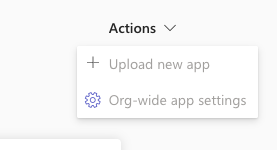
Open Teams apps → Manage apps, choose Actions → Org-wide app settings, and make sure Custom apps → Let users interact with custom apps is On.
If you also want people to be able to upload the package themselves rather than having it published for them, open Teams apps → Setup policies → Global (Org-wide default) and switch Upload custom apps on. This is off in a new tenant.
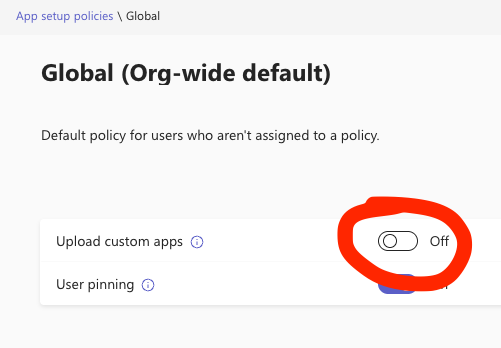
Teams caches app policies. A change in the admin centre can take a few hours to reach the Teams client, and signing out and back in speeds it up. If an Upload button is missing in Teams after you changed a policy, this is why — not the package.
2. Upload the Twelfth app package
Back on Manage apps, choose Actions → Upload new app and pick the twelfth-teams-<workspace>.zip file downloaded from Twelfth. The app appears in your organisation’s catalogue as twelfth, publisher twelfth.
Do not unzip the package or re-zip the folder: Teams expects manifest.json and the two icons at the root of the archive, exactly as supplied.
3. Make it available
Select twelfth in the app list and set Available to — everyone, or the teams and people who should have it. You can also pin it for people through an app setup policy so it appears in their left rail without a search.
Using it
In Teams → Apps, the app is under Built for your org as twelfth. Choose Add, then:
- Direct chat — ask it something. The answer lands in your own chat with it.
- Channels — add the app to a team, then @twelfth in any channel of that team. Twelfth answers in the thread.
- Group chats — add twelfth to the chat and @mention it.
Ask the same things you would ask in the assistant: which SKUs in your remit are trending down, what a supplier’s fill rate looks like this month, or what changed in a competitor’s pricing. Type Help for what it can answer here.
A Teams channel is inside your own tenant, so Twelfth will answer a question in a shared channel — every reader is already someone your organisation admitted. It still answers each person within their remit.
Manage
Once on, the page shows On and two tabs:
- Conversations — the channel conversations Twelfth has answered in. A one-to-one chat with twelfth is that person’s own: it lands in their chat history and is counted here, never named.
- Settings — who is recognised (verified members, by their Teams work email), whether shared channels are answered (yes), and Turn off, which stops Twelfth answering in Teams for this workspace.
The Comms & chat card’s pill says whether the app is in Teams. Removing the app from your tenant is done by your Microsoft 365 administrator in the Teams admin centre; turning it off in Twelfth does not uninstall it — the app stays in your tenant and you can turn this back on at any time.
Related
- Comms & chat — every messaging surface in one place
- Slack and Google Chat — the other surfaces
- Notifications — how each person receives briefings and alerts